Why Clinic Marketing Partnerships Fail: 8 Patterns We See

Vishnu Swaroop Lal
Clinic growth expert, founder of MangoEyes
Published 28 October 2026
12 min read

Short on time? Summarise this guide with:
The clinic growth newsletter
One step-by-step guide a week, for clinic owners
How patients find clinics on Google, ChatGPT and Instagram, and how to win them. Each guide comes with the video and the podcast episode.
By subscribing you agree to receive emails from MangoEyes. Unsubscribe any time. See our privacy policy.
Any agency working in isolation that claims 100% success isn't being honest. We are not an agency. We are experts in building patient journey ecosystems.
We use a holistic approach that takes 180 days to transform your clinic into a Revenue Generating Department. We invest heavily upfront in your business, and you invest alongside us. So we identify these failure patterns now, so we don't discover later, after mutual investment, that we are not the right fit.
We'd rather lose you now than fail together later.
Why are clinic owners different?
Most clinic owners in aesthetics didn't come from business backgrounds. You trained in medicine, nursing or dentistry. You're an expert in your clinical field. You've built something real.
But this creates specific challenges when it comes to marketing partnerships.
- The expertise trap. You're used to being the authority. When a patient questions your treatment recommendation, you have the knowledge and credentials to guide them. But marketing isn't your expertise. Highly intelligent clinical experts often struggle to give up control over areas outside their training.
- The protection instinct. Because you didn't train in business, there's often fear under the surface: a need to protect what you've built, to not be taken advantage of, to appear knowledgeable even in areas where you're not. This fear is understandable. But it's also the thing that most often sabotages growth.
- The secrecy reflex. We've noticed something: clinic owners who get great results often don't want others to know. They've found an edge and they want to keep it. So when someone asks "does MangoEyes work?", they stay quiet, or even downplay their results. You're likely hearing negative stories from people protecting their advantage.
Here is exactly when a partnership doesn't work.
Pattern 1: What is the appointment culture gap?
The four costs
When you take the Revenue Generating Department, there are four costs involved:
- MangoEyes cost: our base fee and performance fee.
- Appointment setter cost: the dedicated person converting leads.
- Ads cost: the financial fuel for the campaigns.
- Tools cost: the CRM, AI calling and tech infrastructure.
What clinics say
When we close a clinic, they often say: "Oh, we have somebody who can do the appointment setter work. I know her. She's good. She's been with us for years. Even my wife can do it."
That's fine. If you want to use your own person, you can. But here's the condition: that person must be trained in our way.
Where it breaks
If you want to use your own person but also want them to follow your own culture, your own process, your own way of doing things, it won't work.
We've perfected the patient journey from lead to booking over 6 years. Our scripts, our timing and our follow-up sequences work. But only when they're followed exactly.
When results don't come, clinics say: "We did everything with MangoEyes and it didn't work." But they never say: "We followed our same old culture of appointment booking. We never adopted MangoEyes' way."
You have two choices
- Option 1: Let us build and train your appointment setter team. We hire, we train, we manage. You get results.
- Option 2: Use your own person, but that person must be trained in the MangoEyes way. Our scripts. Our timing. Our systems. No mixing with your old culture.
Pattern 2: What happens when the focus shifts from revenue to assets?
How it starts
You approach us because you want more patients. Predictable bookings. Growth from £50k a month to £100k a month. This is exactly what the Revenue Generating Department is built to deliver.
What happens
The partnership works. Revenue increases. You start feeling more confident. And then your focus shifts.
Instead of asking "how do we grow more?" and "what else should we do to increase flow and give patients a better experience?", you start asking different questions:
- "Who owns these 90 to 110 videos you're shooting every 90 days?"
- "Can I have the landing pages you've built on your server?"
- "Can I own these things? They're so beautiful. How have you built everything?"
Why this breaks things
Remember what you're paying. With the Rental Model, you pay a base fee that's one-tenth to one-twentieth of the true infrastructure cost. We finance the gap. You get access to a system worth 20x what you're paying.
The content, videos, landing pages, CRM workflows and AI calling scripts were built by MangoEyes, funded by MangoEyes and tested across hundreds of clinics by MangoEyes. Your payment gives you access and results. It doesn't give you ownership of assets you didn't pay to create.
The furnished flat analogy. Imagine renting a luxury, fully furnished flat. Everything is set up. You move in immediately, at a fraction of what buying and furnishing it would cost. Six months later, you demand to own the sofa and the television because you've been paying rent. That's not how renting works. You paid for access and use, not equity.
If ownership matters to you
This is exactly why we offer the Ownership Model. Choose Asset Ownership (12 months) or Instant Ownership (month to month) and you own every video, page and system from the start. The investment is higher because you're paying for creation, not just access.
But don't choose Rental and then demand ownership. That misalignment breaks partnerships.
Pattern 3: What is the control paradox?
How it starts
You hire us because your own marketing wasn't delivering. Maybe you tried SEO for 3 years and your website still gets 900 visitors a month. Maybe you've cycled through agencies that promised Google rankings and delivered nothing. Maybe your social media never turned into bookings.
What happens
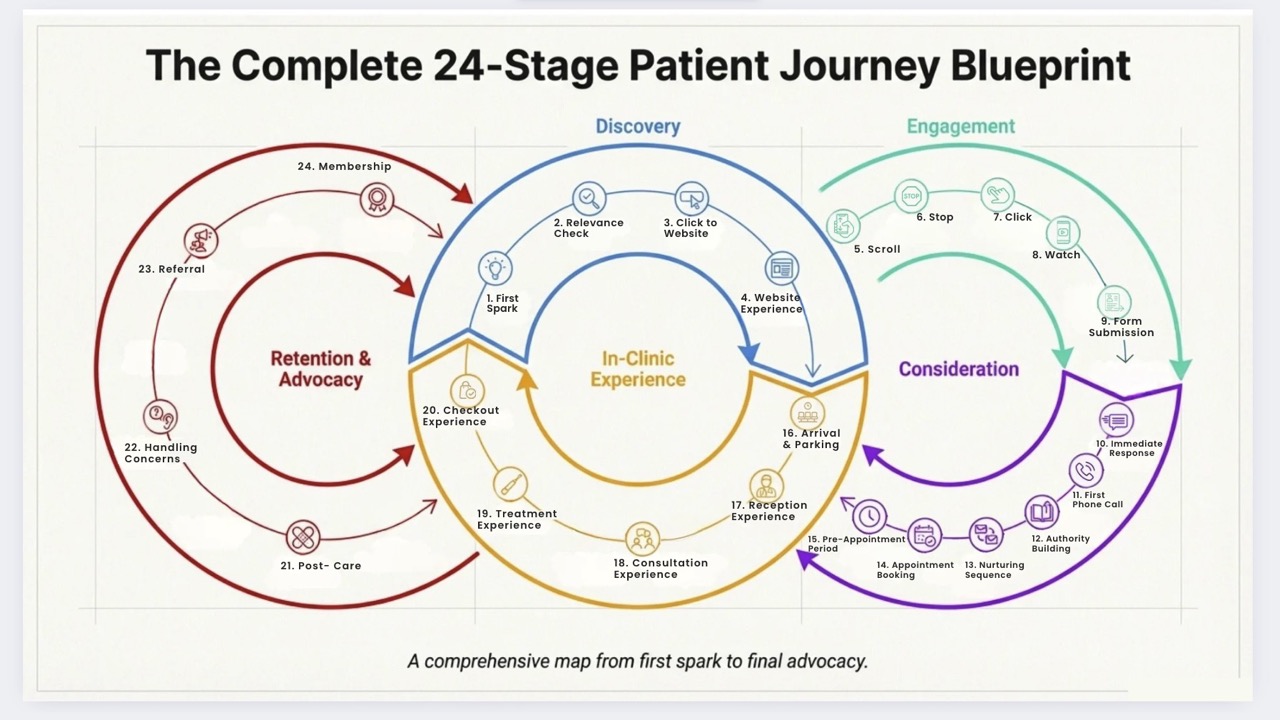
We begin implementing the 9-stage patient journey system. Within weeks, you're suggesting changes:
- "I think the ads should look different."
- "My friend's clinic is doing well on TikTok, we should do that."
- "I read an article saying we should change our approach."
- "Can we try this instead?"
Why this breaks things
You hired experts because your methods failed. But now you're trying to direct the experts based on those same failed methods.
This is like a patient telling you, the clinical expert, how to perform their treatment because they watched a YouTube video. You would never accept that. Neither can we.
The deeper issue
This pattern usually comes from the expertise trap. You're used to being the authority in your field. Letting someone else lead feels deeply uncomfortable. Your instinct is to evaluate, question and direct.
But marketing isn't your field. The Professional Narrative Engine, the Psychological Hook Architecture and the Omnichannel Ad Warfare strategy were developed through 6+ years of niche research and testing. They work. But only if you let them.
The paradox
The very intelligence and expertise that made you successful clinically can undermine you here. You're smart enough to have opinions about everything. But having opinions and having expertise are different things.
Pattern 4: What is the expense mindset?
How it starts
You sign up. The partnership begins. You see the base fee (£2,700 to £6,500 a month, depending on your model), plus the 4% performance fee on new revenue, plus the £70 a day minimum ad spend.
Money is leaving your account.
What happens
Even though revenue is growing, even though new patients are booking, even though the system is working, you focus on what's going out:
- "That's £5,000 leaving my account this month."
- "Do we really need all 5 Pillars?"
- "Can we reduce the ad spend for a few weeks?"
- "Is the Setter role really necessary?"
Why this breaks things
If the system generates £5 for every £1 you invest, cutting that £1 doesn't save you money. It costs you £4.
But clinic owners without business backgrounds often struggle with this maths. They see money leaving and feel discomfort, even when significantly more money is coming in. The emotional response overrides the logic.
The result is cost-cutting that damages the very machine generating the growth. Reducing ad spend below £70 a day means insufficient data for the algorithm. Removing The Setter means leads go cold. Cutting back on content means ad fatigue sets in.
The mindset shift required
Marketing isn't an expense. It's infrastructure. It's your Revenue Generating Department.
You wouldn't save money by removing a treatment room from your clinic. You wouldn't cut your receptionist to reduce overheads if that receptionist was booking £50k a month in treatments.
The base fee, performance fee and ad spend aren't costs to minimise. They're fuel for a machine that multiplies your investment.
What we mean by "total alignment"
We've invested so heavily that we cannot afford to fail. Our only path to profit is your long-term growth, through the 4% fee. If you don't grow, we don't profit. We're aligned.
But that alignment only works if you see this as an investment, not an expense.
Pattern 5: What is systems resistance?
How it starts
We install the complete Digital Architecture: the Patient Education Platform, the CRM with automated nurturing sequences, the Lead Firewall, the AI Calling Infrastructure and the Unified Hub that filters leads so only qualified patients enter your clinic diary.
Everything is ready.
What happens
You don't use it.
Your team keeps tracking patients on Excel spreadsheets. You don't log in to the dashboard. The workflows we programmed don't get followed. When we ask why, you say "we're too busy", "our old way works fine" or "we'll get to it".
Why this breaks things
The 5 Pillars are interconnected. Every piece talks to every other piece.
When you track patients on Excel instead of the CRM, we can't see where leads are dropping off. When The Setter doesn't follow the scripts, conversion rates fall. When you don't use the Unified Hub, unqualified leads clog your diary while qualified ones slip away.
The AI Calling Infrastructure trains itself on data. No data, no training, no improvement. The algorithm optimises based on feedback loops. Break the loop, and you break the optimisation.
You must operate the machine
We built you a Formula 1 car. If you try to drive it like a bicycle, it won't work.
Success requires adopting the systems. It means changing how your front desk operates. It means using the dashboard daily. It means trusting the technology.
The clinic growth newsletter
One step-by-step guide a week, for clinic owners
How patients find clinics on Google, ChatGPT and Instagram, and how to win them. Each guide comes with the video and the podcast episode.
By subscribing you agree to receive emails from MangoEyes. Unsubscribe any time. See our privacy policy.
Pattern 6: What is the "let me try" mentality?
How it starts
You see the ads we've created. You see the landing pages. You see the scripts. And you think, "I can do that."
What happens
You start modifying the copy. You edit videos yourself. You change the landing page headlines. You think you're helping. You think you're adding your "personal touch".
Why this breaks things
Our copy isn't written to sound nice. It's written to convert. It uses psychological triggers (pattern interrupts, open loops, urgency anchors) that have been tested across millions of pounds of ad spend.
When you change a headline because "it sounds better", you often break the psychological hook. When you edit a video to make it "more professional", you might remove the raw authenticity that drives engagement.
Trust the data, not the feeling
We don't guess. We test. If we're using a specific headline, it's because it beat 50 other headlines in A/B testing.
Your subjective preference ("I like this better") cannot compete with objective data ("this converts 30% better").
Pattern 7: What is the 5-minute problem?
How it starts
Leads start coming in. The phone is ringing. The dashboard is lighting up.
What happens
You call them back 4 hours later. Or the next day. Or you email them instead of calling.
Why this breaks things
Speed to lead is everything. A lead called within 5 minutes is 21x more likely to qualify than one called after 30 minutes.
In the aesthetics market, patients are impulsive. They want a solution now. If you don't answer, they call the next clinic.
The infrastructure solution
This is why we provide The Setter and the AI Calling Infrastructure. We make sure leads are contacted instantly, 24/7.
But if you insist on handling the calls yourself, or switch off the AI because "I want to speak to them personally", and then fail to call instantly, the leads die. And you blame the lead quality.
Pattern 8 (the hidden pattern): What is FOMO and strategy-hopping?
How it starts
The campaign is live. It's week 3. Results are steady. But then you attend a conference. Or you see a competitor doing something different. Or a "guru" on Instagram says "Facebook ads are dead, you need to be on TikTok Shop."
What happens
You get the fear of missing out. You worry that while we're building a stable, long-term infrastructure, there's a "magic bullet" somewhere else that you're missing.
You ask us to pause the strategy we agreed on and pivot to the "new thing". Then 3 weeks later, when the new thing hasn't instantly worked, you want to pivot again.
Why this breaks things
Marketing momentum is real. Algorithms need time to learn. Audiences need time to trust. Every time you pivot strategy, you reset the clock to zero.
Strategy-hopping is the fastest way to burn budget with zero results. It prevents any single approach from gaining traction.
Boring is profitable
Great infrastructure is often boring. It's consistent. It repeats what works. It doesn't chase trends.
If you need the dopamine hit of "new and exciting" every month, you'll struggle with a system built for stability and scale.
What is the "Stay in Your Lane" agreement?
We have a simple rule for successful partnerships:
- You are the clinical expert. You decide which treatments are safe. You decide the clinical protocols. You make sure patient care is world-class. We never question your clinical judgement.
- We are the growth experts. We decide the ad strategy. We decide the copy. We build the landing pages. We set the automations. You trust our judgement on how to bring patients through the door.
When these lanes are respected, magic happens. You focus on being an incredible clinician. We focus on filling your diary.
When the lanes are crossed, when you try to be the marketer, or (God forbid) we tried to be the doctor, disaster follows.
What is our promise to you?
We will never try to tell you how to inject. We will never question your medical diagnosis.
In return, we ask that you trust us to build the infrastructure you hired us to build.
If you can do that, if you can resist the urge to control, the fear of expense and the temptation to tinker, we can build something extraordinary.
If you can't, please don't apply. It saves us both a lot of stress.
If you've read this far and you understand, check your eligibility. If you'd like to talk it through first, book a consultation.
Short on time?
Summarise this guide with AI
Frequently asked questions
›Why do marketing partnerships with clinics fail?
We see eight patterns. Partnerships fail when the clinic keeps its old appointment culture, shifts focus from revenue to owning the assets, tries to direct the experts, treats marketing as an expense, doesn't use the systems, edits the work, calls leads back too slowly or keeps switching strategy.
›Can I use my own receptionist as the appointment setter?
Yes, but that person must be trained in the MangoEyes way: our scripts, our timing, our systems, with no mixing with your old culture. If you choose this option, the 180-day transformation guarantee does not apply.
›Do I own the videos and landing pages you build?
With the Rental Model you pay for access and results, not ownership, because MangoEyes funds the infrastructure. If ownership matters to you, choose the Ownership Model (Asset Ownership over 12 months or Instant Ownership month to month) and you own every video, page and system from the start.
›How fast should a clinic call back a new lead?
Within 5 minutes. A lead called within 5 minutes is 21x more likely to qualify than one called after 30 minutes. That is why The Setter and the AI calling infrastructure contact leads instantly, 24/7.
›Can we reduce the ad spend for a few weeks?
Reducing ad spend below £70 a day means insufficient data for the algorithm. If the system generates £5 for every £1 you invest, cutting that £1 doesn't save you money. It costs you £4.
›What is the 'Stay in Your Lane' agreement?
You are the clinical expert: you decide treatments, protocols and patient care, and we never question your clinical judgement. We are the growth experts: we decide the ad strategy, the copy, the landing pages and the automations.
Listen to this guide
Clinic Growth Explored, the podcast
The clinic growth newsletter
One step-by-step guide a week, for clinic owners
How patients find clinics on Google, ChatGPT and Instagram, and how to win them. Each guide comes with the video and the podcast episode.
By subscribing you agree to receive emails from MangoEyes. Unsubscribe any time. See our privacy policy.