Why Clinic Marketing Fails: Buzzwords, Isolation and the Missing Architecture

Vishnu Swaroop Lal
Clinic growth expert, founder of MangoEyes
Published 28 October 2026
6 min read
Short on time? Summarise this guide with:
The clinic growth newsletter
One step-by-step guide a week, for clinic owners
How patients find clinics on Google, ChatGPT and Instagram, and how to win them. Each guide comes with the video and the podcast episode.
By subscribing you agree to receive emails from MangoEyes. Unsubscribe any time. See our privacy policy.
Agencies sell you "buzzwords" (SEO, ads) to bring traffic. But they work in "isolation", in silos. Nobody connects the dots. That is the problem with most clinic marketing, and it is why so many clinics pay for traffic that never becomes patients.
In this article I break down the two parts of the problem, the traps that come with them, and what we build instead.
Why do agencies sell clinics buzzwords?
These are the buzzwords clinics are sold every week:
- SEO
- Social media
- Google Ads
- Facebook Ads
- Email marketing
- Lead generation
- Website creation
- AI marketing
The result: you get traffic.
Agencies sell "SEO" (traffic) and "AI marketing" (just a tool) because these buzzwords make it easy to collect cash. They are selling you a commodity.
But a text-based website is not enough. You need to understand the sequence: when to use the tools to attract attention, and when to use them to nurture. You must prepare your architecture in advance, so the traffic actually converts.
Agencies don't do this because it requires high mastery and investment. It's easier to just sell the "parts".
Why does buying marketing in isolation fail?
This is the reality when every part of your marketing is bought separately:
| Who | What they tell you |
|---|---|
| The SEO guy | "I delivered the traffic. My job is done." |
| The web developer | "I built the page. The content is your job." |
| The ad agency | "We got you clicks. Why aren't they buying?" |
The result: no conversion.
Nobody is working to convert the same patient who visits. You have traffic, but no system to hold her. This is the gap in your leadership.
What is the discount trap?
This is the low marketing scam: why agencies push you to offer discounts instead of building your brand value.
Agencies see that your profile isn't ready to sell high-ticket treatments. Instead of doing the hard work to build your authority, they take the easy route: "Give a discount."
The cycle of failure:
- They lower the price to get easy clicks.
- You attract bargain hunters (a £30 to £200 budget).
- These leads ask "How much?" and never book premium packages.
A typical conversation with one of these leads looks like this:
Patient: "Hey, I saw your 50% off deal. Can I get it? Can you tell me more info?"
Clinic: "Hi, thank you for contacting us! Can I get your first name?"
The patient left the chat. No reply.
And then the agency tells you: "Your team cannot convert!" They blame you for their bad bait.
Why are you proposing on the first date?
Focusing only on "attention-grabbing" activities (the buzzwords) without having the infrastructure is like meeting someone and asking them to marry you immediately.
It will not happen.
Patients need to go through your entire system architecture. You need to appear on their device again and again. If you only focus on the first activity (attention), you are missing the depth required to build a relationship (conversion).
Why are you only fighting for the 3%?
Most clinics focus only on the "hyper buyers": the 3% ready to buy right now. But 97% of the patients visiting your site are browsers. They are paid for by your ad money, but they aren't ready to book yet.
The clinic growth newsletter
One step-by-step guide a week, for clinic owners
How patients find clinics on Google, ChatGPT and Instagram, and how to win them. Each guide comes with the video and the podcast episode.
By subscribing you agree to receive emails from MangoEyes. Unsubscribe any time. See our privacy policy.
Why do clinics fail to convert?
You are relying on "tools" (buzzwords) to do a job that requires "psychology" (the soul) and "strategy" (the sequence). The reason you propose on the first date is that you don't know what to say next.
The soul: the "why"
The soul is the internal psychology that hooks the patient. Your marketing has to answer six questions:
| Question | What it means |
|---|---|
| Why click? | Once you reach them, what gives them a reason to stop scrolling? |
| Why stay? | What holds them in the first 3 to 5 seconds? |
| Why watch? | What compels them to consume your content instead of leaving? |
| Why contact? | Why will they fill in the form, or click to call? |
| Thumb friendly? | Do your website, platform and content work for the thumb? |
| Why remember? | Why will they remember your brand once they bounce back? |
The sequence: the "what next"
The sequence is the external architecture that guides the patient. Each action decides what she sees next:
| What she does | What she sees next |
|---|---|
| Watches a video | Your brand story |
| Visits a landing page | Retargeting with related education |
| Reviews a case study | Social proof |
| Visits your Instagram profile | Directed to specific highlights |
| Sees you at night | A "Good morning" reminder |
This isn't just philosophy. This is the difference between a £50 lead who ghosts you and a £2,000 patient who trusts you before she walks in.
Casino approach or infrastructure approach: which are you choosing?
The choice is yours.
| The casino approach | The infrastructure approach | |
|---|---|---|
| What you do | Keep buying buzzwords (SEO, ads, posts) like lottery tickets, hoping one attention grab will magically turn a stranger into a loyal patient. | Build the soul (why) and the sequence (what next) into one Digital Architecture that predictably turns strangers into believers. |
| Result | Proposing on the first date | Predictable conversion |
MangoEyes doesn't just sell you the ads. We build the architecture that makes the ads profitable.
What is Digital Architecture?
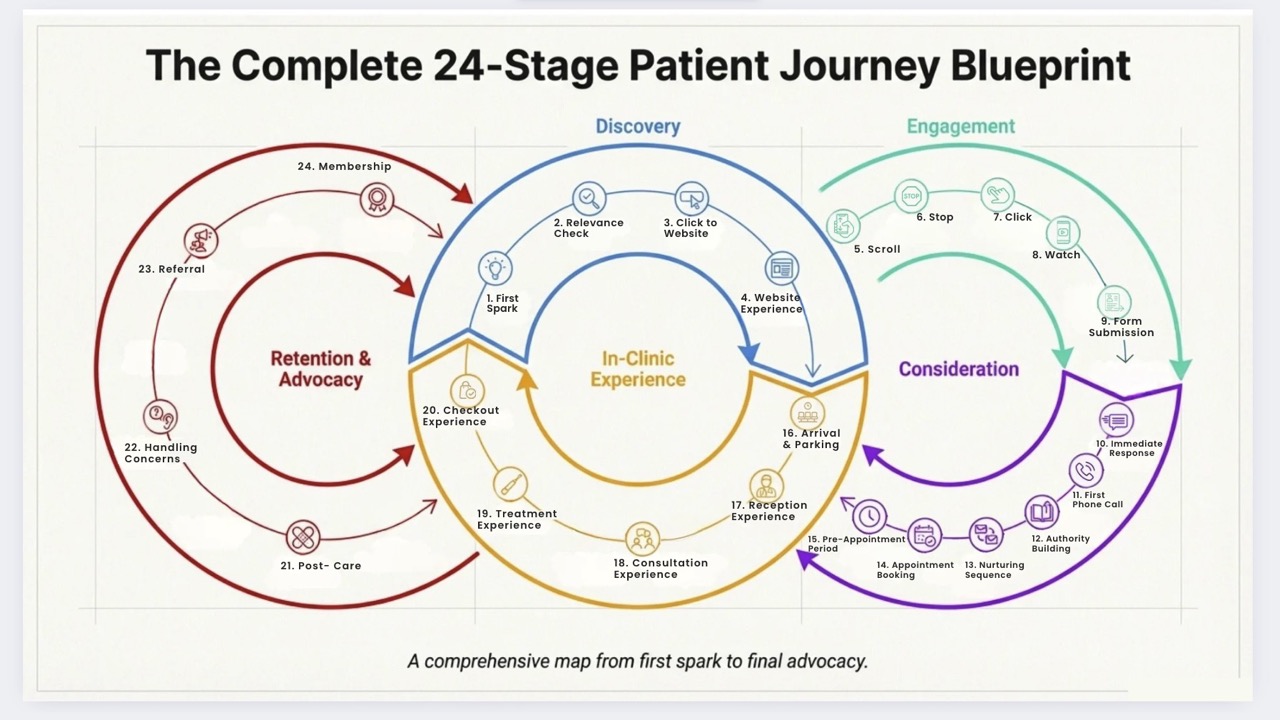
Digital Architecture is using the tools to attract patients, mapping relevancy, adding content and using science to create the engagement loop.
It keeps everything so premium that when patients see the price, they don't give it a second thought. It sets your elevated status so high that they wouldn't even think to bargain with you.
It works in three steps.
Step 1: The reach (the buzzwords)
Ads, SEO and social media generate the traffic. This is just the "invitation".
Step 2: Relevancy mapping (the "click" moment)
Take a patient who searches for "best lip filler clinic".
| The old way | The new standard | |
|---|---|---|
| Where she lands | A generic homepage | A specific education portal: a lip filler education system |
| How it feels | Confusing. Where do I go? | Relevant, engaging and educational |
| What it answers | Nothing specific | Every specific question: Does it hurt? What's the downtime? Is it permanent? How much does it cost? Am I a good candidate? What if it goes wrong? |
Step 3: The engagement loop
- Scroll. The patient lands and begins exploring.
- Stop. Relevant content hooks her attention.
- Watch. High-value education builds trust.
Then the loop repeats: the cycle of retention.
To build this architecture, you don't need isolated vendors. You need a unified team working in sync. That's MangoEyes.
Is your clinic ready for this?
If you'd rather build the architecture than keep buying lottery tickets, check your eligibility. If you're ready to talk it through, book a consultation.
Short on time?
Summarise this guide with AI
Frequently asked questions
›Why does my clinic get traffic but no bookings?
Because the tools that bring traffic (SEO, ads, social media) are bought in isolation. The SEO provider delivers visits, the web developer builds the page and the ad agency gets clicks, but nobody is working to convert the same patient once she arrives. Without that system, traffic comes and goes.
›What are marketing 'buzzwords'?
SEO, social media, Google Ads, Facebook Ads, email marketing, lead generation, website creation and AI marketing. They are tools. Agencies sell them because they are easy to sell, but a tool on its own does not turn a stranger into a patient.
›Why are discount offers a trap for clinics?
A discount gets easy clicks, but it attracts bargain hunters with a £30 to £200 budget. They ask 'how much?', rarely reply and never book premium packages. Then the agency blames your team for not converting them.
›What is the 97% problem?
Most clinics only chase the 3% of visitors who are ready to book right now. The other 97% are browsers. You have paid for them with your ad budget, and if you have no way to hold, nurture and educate them, most of that budget is wasted.
›What is Digital Architecture?
It is using the tools to attract patients, mapping relevancy so each search lands on the right content, adding education that answers every question, and building an engagement loop that keeps your clinic in front of the patient until she is ready to book.
›What is the difference between the 'Soul' and the 'Sequence'?
The Soul is the 'why': why a patient clicks, stays, watches, contacts you and remembers you. The Sequence is the 'what next': what she sees after she watches a video, visits a page, reads a case study or looks at your Instagram.
Listen to this guide
Clinic Growth Explored, the podcast
The clinic growth newsletter
One step-by-step guide a week, for clinic owners
How patients find clinics on Google, ChatGPT and Instagram, and how to win them. Each guide comes with the video and the podcast episode.
By subscribing you agree to receive emails from MangoEyes. Unsubscribe any time. See our privacy policy.